


G.J. Rowlands
International Livestock Research Institute (ILRI), P.O. Box 30709, Nairobi, Kenya
E-mail: j.rowlands@cgiar.org
The ultimate goal of this workshop is to seek ways that African institutions can work together to improve their capacity in applied biometry. By achieving closer collaboration between national agricultural research institutions (NARIs) and universities opportunities for sharing resources, including the licensing of statistical software, can be facilitated. A number of papers in this proceedings (e.g. Agwanda; Das; Keogh; Janssen; Mugasha and Shemwetta; Nabasirye;) alude to the need to establish and maintain better links among biometricians within the region. The existence of SUSAN (Sub-Saharan African Network of the International Biometric Society) is a positive asset, but within the region covered by this workshop there may be a need for a more focused network of committed biometricians who can work together to improve both the quality of biometric input into agricultural and medical research and the image of biometrics too. This paper addresses this possibility.
Many papers in this proceedings have emphasised the shortage of applied biometricians in NARIs. There is a clear need, therefore, to improve the output of well-trained graduates in applied biometrics from universities. To do this the capacities to teach biometrics in one or two of departments of mathematics/statistics in universities in the region need to be strengthened and regional BSc and MSc courses in applied biometrics initiated. Following the development of course curricula additional assistance can be provided as follows:
Figure 1 illustrates a possible scenario with two lead universities each with BSc and MSc programmes in applied biometrics. As soon as lecturers gain experience and confidence in teaching the new syllabus, their knowledge can be shared with staff in other universities who wish to introduce applied biometric components into existing mathematics/statistics courses or who wish to improve courses in biometrics to students in life sciences. As linkages between universities develop so also will linkages with NARIs. Figure 1 conceptualises a future network of universities and NARIs in East and southern Africa.
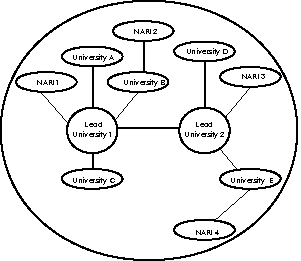
Figure 1.A conceptualised network of universities and national agricultural research institutes for the purposes of strengthening institutional capacities in applied biometrics in East and southern Africa.
In order to maximise the benefits gained from linkages between national institutions in the region it will be important to broaden the network to encompass other institutions and networks within and outside the region as illustrated in Figure 2. For instance, existing regional agricultural research networks in East and southern Africa recognise the subjects of experimental design, statistical analysis, interpretation and presentation of results to be among the top priorities for training of scientists. An increased biometric input into the research of these networks would be an important step and raise the profile of biometrics in the region. Coe (this proceedings) describes possibilities for enhancing the contributions that international agricultural research centres (IARCs) can make in increasing the capacity and effectiveness of biometricians in national agricultural research systems (NARS). Potential benefits achieved from close collaboration with advanced institutions abroad are also emphasised (e.g. Dicks and Njuho; Janssen, this proceedings). Various institutions can be linked to extend the network as conceptualised in Figure 2.
It is likely that a steering group will be necessary to allow such a network to function efficiently (Figure 2). Such a group, modelled on other existing research networks, could, for instance, comprise a representative from each of Kenya, Malawi, Tanzania, Uganda and Zimbabwe who would elect a chairman from amongst themselves. Two other members could also join the steering group, namely a representative from the IARCs, to provide, in the initial stages, the secretariat and a representative from other advanced institutions. The terms of reference of the steering group could cover such activities as:
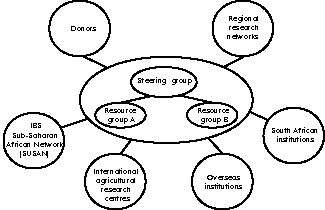
Figure 2.Management of the network conceptualised in Figure 1 through a steering group and resource group of committed biometricians and linkages to outside organisations for which assistance may be needed.
Stern and Allan (this proceedings) demonstrate how a team of biometricians from both national and international institutions were put together to conduct a training programme of biological scientists in Guinea in West Africa. Such a model could be readily applied to countries (or institutions within countries) in East and southern Africa. By following a strategy of strengthening the capacity of existing national biometricians through attachments to biometricians in European or South African universities or to biometricians in IARCs (as outlined by Riley in her review of the CTA study) resource groups of trained, national biometricians could be put together to conduct courses for other biometricians and scientists in the region. The inclusion of two resource groups A and B, for illustrative purposes, completes the conceptualisation of Figure 2. An additional function of the steering group would be to ensure that such resource groups are established and sustained.
Reactions of participants at this workshop to these suggestions are needed. If there is a general acceptance of these ideas then the next step would be to appoint a steering group. This would be one approach to ensuring that initiatives taken at this workshop have possibilities of reaching fruition.
