

The papers included in this proceedings were presented at a workshop on `The Enhancement of Capacity in Applied Biometry in East and southern Africa' covering Kenya, Malawi, Tanzania, Uganda and Zimbabwe (referred to as the `region' throughout this proceedings ). The workshop was financed by The Rockefeller Foundation and held at the International Livestock Research Institute (ILRI) from 7th to 9th December, 1999. The papers have been grouped together against the different facets of the current status of biometrics both within and outside the region.
The first three papers set the scene by describing the changing nature of agricultural research in the region and its impact both on the biometrics methods needed now and in the future and on the future role of the biometrician. The need for biometricians to be proactive and to get more involved in collaborative approaches with scientists is emphasised.
These three papers are followed by a series of other papers that discuss the current status of biometrics in various national institutions in the region. The situation in the different national research institutes researching in crops, forestry, livestock and medicine is highlighted in the first nine papers. These are followed by five papers describing the position of biometrics training in the Statistics Department of the University of Zimbabwe and in faculties of Agriculture and Forestry in Kenya, Uganda, Tanzania and Malawi. Each of the 14 papers concludes with suggestions on what is needed to enhance the capacity in biometrics in their respective institution. The final paper in this session provides an overview of the general situation in Africa, Caribbean and Pacific countries and discusses the common factors underlying the lack of progress in the acquisition of appropriate biometric skills.
These papers may leave the general impression that current biometrics capacity within NARS (national agricultural research systems) is grossly inadequate to meet the changing agricultural research scene in the region. Nevertheless, the papers that follow suggest that the picture should not be too gloomy. Two papers describe the opportunities for advanced training in biometrics in South Africa and Belgium for students from the region. These are then followed by various papers describing various new initiatives within and outside the region. Two papers, for example, emphasise opportunities that have been made and the benefits achieved from linkages between university departments in Nairobi and ILRI. Examples of approaches for training in West Africa applicable to East and southern Africa, and their adoption in the improvement of teaching of biometrics to agricultural students at the University of Reading, UK. Looking further to the future the possibility of international agricultural research institutes in the region pooling their resources to provide more effective and structured capacity building to NARS is considered. The next paper proposes a collaborative approach among the various groups represented at the workshop in the development of training resources for use by biometricians and scientists within the region. The final paper describes INSTAT+, a computer statistical teaching aid developed by the University of Reading, that could play a significant role in the development of future training resources.
The need for research networks and better communication among biometricians is repeatedly emphasised throughout these proceedings. The last two papers describe, firstly an existing network in sub-Saharan Africa (SUSAN), part of the International Biometric Society, and secondly the possible formation of a steering group within the region to oversee the development of linkages between groups of biometricians and scientists in order to foster the enhancement of biometrics capacity in the region.
A number of acronyms appear frequently in the papers that follow. To save repeated definitions in each paper some are described here.
IARC-International Agricultural Research Centre (These belong to the Consultative Group on International Agricultural Research (CGIAR)). Four of these IARCs are:
ICRAF-International Centre for Research in Agroforestry, Kenya
ICRISAT-International Crops Research Institute for the Semi-Arid Tropics, Niger
ILRI-International Livestock Research Institute, Kenya
WARDA-West Africa Rice Development Association, Côte d'Ivoire
NARI-National Agricultural Research Institute. A number are described, e.g.
KARI-Kenya Agricultural Research Institute
KEFRI-Kenya Forestry Research Institute
KEMRI-Kenya Medical Research Institute
NARO-National Agricultural Research Organisation, Uganda
DRSS-Department of Research and Specialised Services, Zimbabwe
DARTS-Department of Agricultural Research and Technical Services, Malawi
LPRI-Livestock Production Research Institute, Tanzania
NARS-National Agricultural Research Systems - a collective term used to included both NARIs and university faculties of agriculture.
LUC-Limburgs Universitair Centrum, Belgium
UNP-University of Natal, Pietermaritzburg, South Africa
ICIPE-International Centre for Insect Physiology and Ecology, Kenya
SUSAN-Sub-Saharan Africa Network, a network of the International Biometric Society.
At the workshop conclusion Professor Paul Janssen gave some observations on the outcomes of the workshop.
"We have a mission, which can only be achieved through high quality work in teaching, consulting and research. By doing so we will be able to convince students and scientists that biometrics has a key role in supporting scientific research in agriculture and medicine. They will then understand and recognise that good statistical practice can give sound scientific grounds to their research. This is a way (or the only way) to help make biometrics popular. However, to realise this mission wemust, as Dr. Hank Fitzhugh, Director General of ILRI, put it when he opened the workshop, "sharpen the tools to increase the impact". We must also revisit the way we work and find out whether ours is the most effective approach.
What practical steps can we take? First, we must build bridges; sometimes it is betterto walk on a small bridge than to run out of breath on a long bridge; moreover a small bridge is cheaper. Indeed, many things are best done on a small scale, e.g. creation of small local working groups to study a new methodology or joint involvement in consulting/research problems. Second, we must put our activities into the picture through the quality of our teaching, consulting and through good P.R.. We need to inform the scientific community of what we are doing - hence the reason for compiling this proceedings. We need to present a positive image in order to influence the policy/decision makers at our universities and institutes.
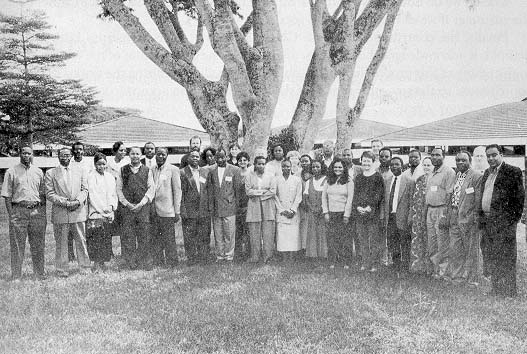
The participants of the workshop on Enhancement of Capacity of Applied Biometry in East and southern Africa.
We need to revisit the target of the training at the university level by updating coursecontent and giving convincing examples to demonstrate the usefulness of statistics. (The paper by Allan and Stern provides an interesting new approach). We need to exchange expertise both within and outside the region and inform each other about opportunities. Small projects are possible, even at the international level (it is easier to find $3000 than $100,000). The region must clearly set its objectives. Progress goes step by step. If you go for big things (journals, books, software) act as a network. If you talk to donors and are thinking big then embed your proposal into a research or development project that clearly fits into the main objectives of the donor.
There is a lot of work to be done. To make progress the workload must be divided.
In conclusion, three quotations from these proceedings which aptly describe the work to be done.
Janssen : "Biometrics is an exciting field in which statistical practice and methodology go hand in hand with research in agriculture, biology, medicine, etc."
Riley : "It is better to manage well a little knowledge than to mismanage a lot of knowledge."
Coe : "If we do not get involved we shall have only ourselves to blame. We cannot blame the customer if we cannot deliver the goods."
Finally, the contribution of Joyce Chege, secretary to the Biometrics Unit of ILRI, Nairobi, is acknowledged, both for her assistance in the organisation of the workshop and in the typing of these proceedings. Dr. Rob Eley was facilitator during the workshop and his contribution to the smooth running of the workshop is also acknowledged.
G. J. Rowlands
Head of Biometrics
ILRI-Nairobi
