


R. Coe
Research Support Unit, International Centre for Research in Agroforestry
P.O. Box 30677, Nairobi, Kenya
E-mail: r.coe@cgiar.org
A biometrician provides support by helping researchers use methods that will be most effective and efficient in reaching research objectives. Traditionally this has meant helping with design the of experiments and surveys and with analysis of data. The research methods that are appropriate depend on the research approach used. For example, determining fertiliser recommendations requires different methods from development of integrated soil management strategies. The type of support needed by scientists depends on the methods used. These in turn determine the skills and training both researchers and biometricians need (Figure 1).
If the focus and approaches of agricultural research change so will the methods and support needed. The biometrician needs to keep one step ahead in anticipating and devising new methods to handle the different ways that agricultural research will be done. But is he? Are biometricians still providing the resource support that is needed?
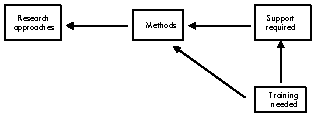
Figure 1. Are we as biometricians providing what is needed?
The agricultural research focus is changing, not just in this region but throughout the world. The research agenda now includes agro-ecosystem research, integrated approaches to problem solving, natural resources management perspectives, participation of farmers and an increasing emphasis on providing information about alternative options rather than on optimal packages. With these changes what role is there for many of our traditional tools, typified by the randomised block design and analysis of variance?
The diagram below illustrates a typical design problem that is encountered in participatory and natural resources research. The study layout has several layers-villages, landscape positions on a gradient within each village, farms in each landscape position, different niches within each farm, plots within niches and trees in each plot.
Many questions arise in selecting an appropriate design for the study. For example, how many sampling units should there be at each level, which units and, if this is a participatory trial, who decides on the choice of units? What intervention should be tested at what level and what should be measured? The answers to these questions will not be found in a standard statistical textbook.
Layer |
How many? |
Which ones? |
Who decides? |
What intervention? |
What is measured? |
Village |
|||||
Landscape position |
|||||
Farm |
|||||
Niche |
|||||
Plot |
|||||
Tree |
The above example is a simple illustration of how research methods are changing, what biometricians will be expected to do and, further, what biometricians must train others to do. There are no recipe books of designs for these new problems. We cannot expect to find classical designs which match researchers' requirements. Instead we will have to apply design principles to each new problem. We shall need to balance theory against practical possibilities in applying these principles.
There will be an increasing emphasis on data management and processing as an integral part of the research process. As biometricians, therefore, we need to develop our skills in designing appropriate data management strategies. We need to increase our range of analytical methods and be prepared to learn from ecologists, economists and sociologists on the techniques they use. We need to see beyond the statistical model and classical significance testing. There will be uncertainty in everything and it will be important to develop our skills in interpreting this variation and make balanced judgements on what conclusions can be drawn.
We also have to change the way we get involved. If we wait for a scientist to come along with a query then it is unlikely we will understand the complex situation sufficiently to be able to contribute much. The biometrician has to be a member of a scientific team. We must make scientists appreciate the contribution that we can make to a team effort. Thus, we must expect the arrows in Figure 1 to point in both directions and to be able to respond when the arrow is pointing back at us. Biometricians are trained to be objective, unbiased thinkers who are able to stand back and judge on probabilistic grounds the likelihood of a scientific result as being genuine or not.
If we do not get involved we shall have only ourselves to blame. We cannot blame the customer if we cannot deliver the goods.
